Many brands experience the same pattern with Meta ads.
The campaigns launch successfully. Early results look promising. Customer acquisition costs feel manageable. Sales increase quickly.
Then scaling begins.
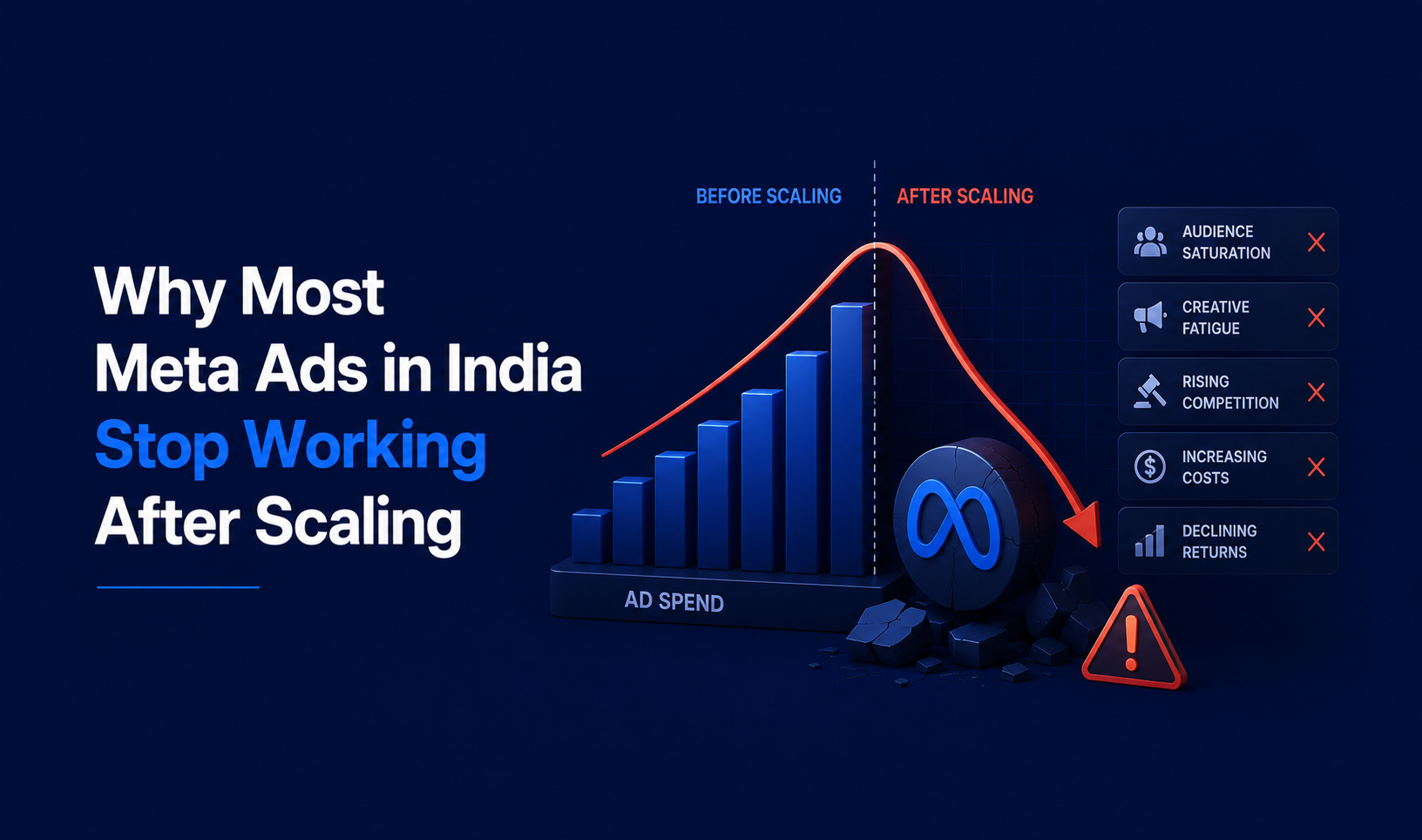
Budgets go up, impressions increase, and performance suddenly becomes unstable. Cost per acquisition rises. Click-through rates drop. ROAS declines. Teams begin testing endless creatives, audiences, and offers trying to recover results.
At that point, most businesses assume the platform stopped working.
Usually, that is not the real problem.
The bigger issue is that many brands in India build Meta advertising systems designed only for short-term traction, not sustainable scaling.
Meta ads can still drive enormous growth when the foundations are strong. But scaling exposes weaknesses that smaller budgets often hide.
Early Success Often Creates False Confidence
In the beginning, Meta advertising can feel deceptively easy.
The platform’s targeting systems are powerful. Even average creatives can sometimes perform well during early testing stages. Businesses see quick conversions and assume the system is fully validated.
But initial traction does not always mean long-term scalability.
Smaller budgets allow campaigns to operate efficiently within narrow audience pockets. Once spending increases, the platform must reach broader audiences.
That is where weak positioning, repetitive creatives, poor retention, and inconsistent branding start becoming visible.
Many businesses mistake early performance for sustainable market fit.
A good performance marketing agency in Delhi or Meta ads India specialist should understand this difference clearly.
Scaling is not simply increasing budget.
It is increasing pressure on the entire brand system.
Creative Fatigue Happens Faster Than Most Brands Expect
One of the biggest reasons Meta ads stop performing is creative fatigue.
Indian consumers are exposed to enormous amounts of advertising every day.
The same formats repeat constantly:
- Generic founder videos
- Overused hooks
- Discount-heavy messaging
- Lifestyle montages
- Before-and-after visuals
- Trend-based reels
Eventually, audiences stop responding.
When scaling campaigns, creative quality becomes more important than audience targeting.
Meta’s algorithm increasingly depends on strong engagement signals. Weak creatives lead to:
- Lower click-through rates
- Rising CPMs
- Poor engagement
- Declining conversion efficiency
The brands that scale successfully usually build structured creative systems instead of relying on a few viral ads.
This includes:
- Multiple creative angles
- Different storytelling formats
- Product education
- Founder narratives
- UGC variations
- Retargeting creatives
- Platform-native content
Creative testing should become a continuous process, not an occasional fix after performance drops.
Weak Branding Makes Scaling Expensive
Many businesses try to scale Meta ads without building a recognisable brand.
This creates dependency on constant acquisition.
When customers do not remember the brand after seeing the ad, every conversion becomes harder and more expensive over time.
Strong branding improves advertising performance significantly.
Customers are more likely to engage with:
- Familiar brands
- Consistent messaging
- Trustworthy presentation
- Clear positioning
- Professional creative direction
This is why some brands maintain efficient advertising even with rising competition.
Their brand equity supports conversion.
A strong branding agency India businesses work with should understand how identity, messaging, packaging, and digital communication affect paid media efficiency.
Brand building and Meta advertising should not operate separately.
The strongest-performing campaigns usually belong to brands that customers already recognise or quickly trust.
Scaling Exposes Poor Customer Experience
Meta ads do not operate in isolation.
Advertising may bring traffic, but conversion depends on the entire customer journey.
As brands scale, weaknesses outside the ad platform become more visible:
- Slow websites
- Weak landing pages
- Confusing messaging
- Poor product-market fit
- Inconsistent customer support
- Low trust signals
- Weak retention systems
Many brands focus only on ad metrics while ignoring post-click experience.
But Meta’s algorithm increasingly rewards businesses that create positive user behavior.
If users bounce quickly, abandon carts frequently, or show weak engagement patterns, campaign efficiency usually declines.
This is why sustainable scaling requires coordination between:
- Advertising
- Branding
- Website experience
- Content
- Analytics
- Customer retention
Performance marketing works best when the overall business experience supports it.
Over-Reliance on Discounts Damages Long-Term Performance
Many brands in India scale quickly using aggressive discount strategies.
Initially, discounts improve conversion rates.
But over time, this creates dangerous customer behavior.
Customers begin associating the brand only with offers.
This creates several long-term problems:
- Reduced brand perception
- Lower profit margins
- Weak customer loyalty
- High acquisition dependency
- Declining repeat purchase quality
Eventually, campaigns struggle unless discounts become even larger.
That cycle becomes difficult to sustain.
The brands that scale more effectively usually combine performance marketing with stronger positioning and customer experience.
Customers buy not only because of pricing, but because they trust the brand itself.
That distinction matters enormously for long-term profitability.
Audience Saturation Happens Faster During Scaling
India has massive internet penetration, but relevant audience pools are often smaller than businesses assume.
Many brands repeatedly target similar customer segments:
- Urban Gen Z users
- D2C shoppers
- Fitness audiences
- Beauty consumers
- Startup founders
- High-intent ecommerce buyers
As budgets increase, campaigns start showing ads to the same users repeatedly.
Frequency rises.
Engagement falls.
Acquisition costs increase.
At this stage, businesses often panic and continuously change targeting.
But the deeper issue is usually lack of audience expansion strategy.
Brands that scale sustainably often:
- Expand creative formats
- Enter adjacent audience categories
- Build stronger organic content systems
- Invest in influencer ecosystems
- Improve retention marketing
- Strengthen brand recall outside paid media
Meta ads scale more effectively when the business itself becomes more visible beyond advertising.
Poor Data Interpretation Creates Bad Decisions
Many businesses react emotionally to short-term performance fluctuations.
One weak week leads to:
- Campaign resets
- Audience changes
- Budget instability
- Creative overhauls
- Constant restructuring
This often damages performance further.
Meta’s systems require stability and learning periods.
A strong social media agency India businesses partner with should understand how to interpret data contextually instead of reacting impulsively.
Not every decline means the strategy failed.
Sometimes performance changes are caused by:
- Seasonal shifts
- Market competition
- Creative fatigue cycles
- Attribution delays
- Consumer sentiment changes
- Platform algorithm updates
Scaling requires patience alongside optimisation.
The goal is building systems that improve gradually over time.
Sustainable Scaling Requires More Than Ads
The brands that continue growing through Meta advertising usually stop thinking only like advertisers.
They begin operating like long-term brands.
That means investing beyond campaign management:
- Strong positioning
- Better storytelling
- Consistent visual identity
- Customer retention
- Organic content
- Community building
- Product experience
- Creator partnerships
Advertising amplifies perception.
If the underlying brand lacks depth, scaling eventually becomes inefficient.
But when branding and performance marketing support each other, Meta ads become significantly more durable.
This is especially important for D2C brand marketing in India, where customer attention is increasingly competitive and acquisition costs continue rising.
Final Thoughts
Most Meta ads in India stop working after scaling because the business tries to scale campaigns before building systems strong enough to support growth.
Creative fatigue, weak branding, audience saturation, discount dependency, poor customer experience, and reactive optimisation all contribute to declining performance.
Meta advertising still remains one of the most powerful growth channels available.
But sustainable scaling requires more than increasing budgets.
It requires building a brand customers trust, remember, and return to after the advertisement disappears.
Mantle International helps brands across India and global markets build integrated branding, advertising, and performance marketing systems designed for long-term scalability. To discuss your growth challenges, reach out at hello@mantle.international or book a call.