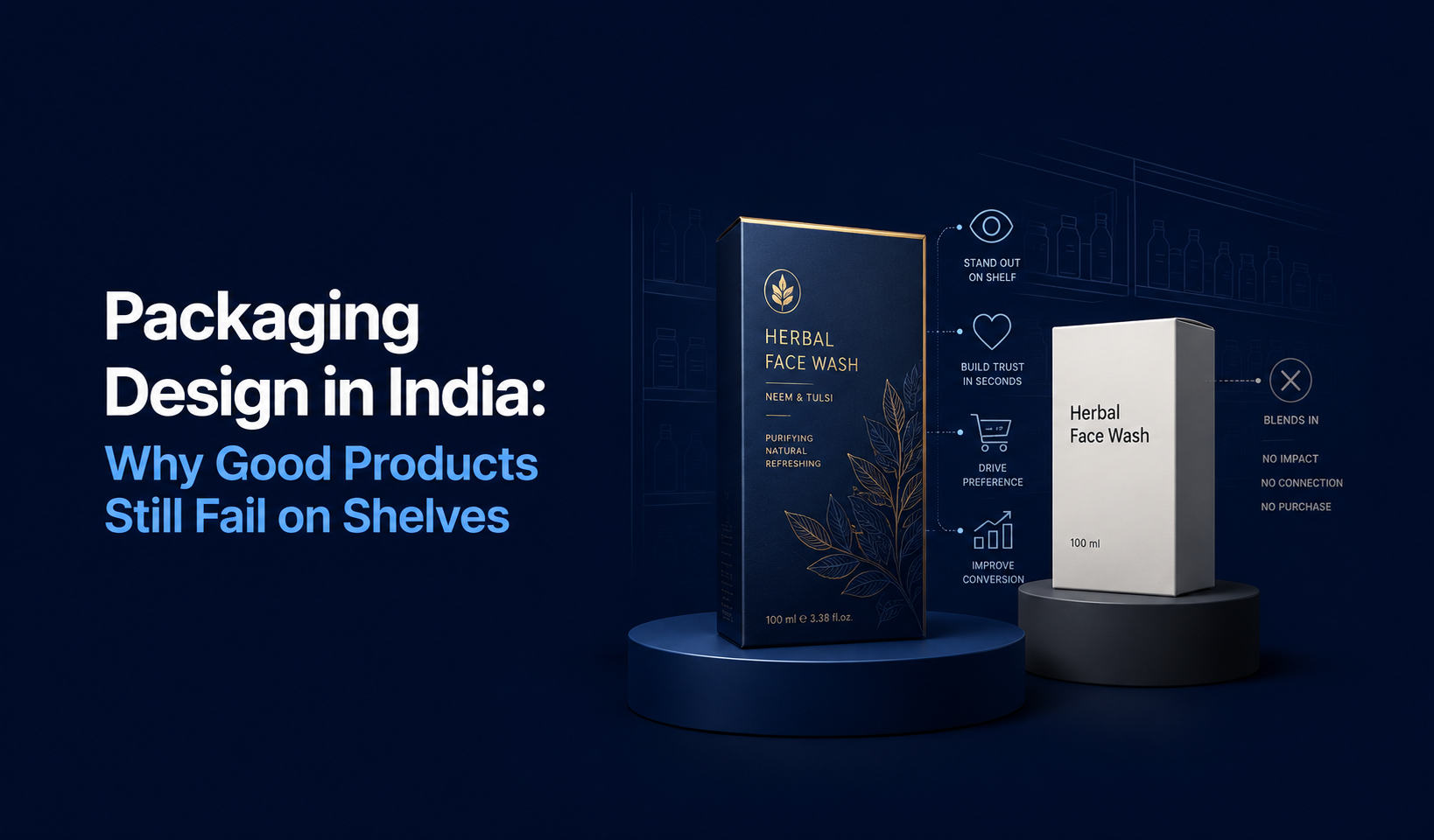
A product can be excellent and still fail to sell.
This happens more often than most brands expect—especially in crowded D2C and retail categories where customers make decisions quickly and visually.
In many cases, the issue is not the product itself. It’s the packaging.
Packaging is often treated as a final design task: choose colors, place the logo, make it look premium. But in reality, packaging plays a much larger role. It shapes first impressions, influences trust, communicates positioning, and directly affects purchase decisions.
If you’re working with a packaging design agency in India or planning to redesign your packaging, it’s important to understand what strong packaging actually needs to do.
Packaging Is Part of Marketing
Many brands separate packaging from marketing.
Marketing teams focus on Meta ads, content, and campaigns, while packaging is handled independently. This creates a disconnect.
In reality, packaging is one of the most important marketing assets a brand has.
It influences:
- Whether someone notices your product
- Whether they understand it quickly
- Whether it feels trustworthy
- Whether it matches the price point
For D2C brands in India, packaging also affects digital perception. Customers often first encounter packaging through Instagram, ads, or creator content before seeing it physically.
This means packaging must work both on shelves and on screens.
First Impressions Happen Fast
Consumers rarely spend much time evaluating packaging.
Most purchase decisions happen within seconds.
This means your packaging needs to communicate clearly and quickly:
- What the product is
- Who it’s for
- Why it’s different
One of the biggest mistakes brands make is trying to say too much. Overloaded packaging creates confusion.
Strong packaging simplifies communication instead of complicating it.
“Premium” Design Is Often Misunderstood
Many brands in India aim for “premium” packaging—but interpret it as minimal design, muted colors, or expensive finishes.
Premium perception is not about trends. It’s about coherence.
Good packaging design aligns:
- Product positioning
- Pricing
- Audience expectations
- Brand identity
A luxury skincare brand and a mass-market snack brand require completely different approaches—even if both want to feel high quality.
This is why copying global packaging trends without strategic context often fails.
Clarity Matters More Than Decoration
Packaging should not rely on customers figuring things out.
A common issue is visual over-design:
- Too many graphic elements
- Hard-to-read typography
- Unclear product hierarchy
The result may look “creative,” but it weakens usability.
Strong packaging design prioritizes:
- Readability
- Product clarity
- Visual hierarchy
- Easy navigation of information
Especially in categories with heavy competition, clarity often outperforms complexity.
Packaging Must Reflect the Brand System
One of the biggest gaps in packaging design is inconsistency with the broader brand.
The website feels modern.
The Meta ads look youthful.
But the packaging feels unrelated.
This disconnect weakens recall and trust.
Packaging should feel like a natural extension of the brand identity:
- Same visual language
- Same tone and positioning
- Same level of quality perception
This becomes even more important when scaling across multiple products or SKUs.
Practicality Is Part of Good Design
Packaging design is not just visual. It’s functional.
A strong packaging system should consider:
- Shelf visibility
- Material choices
- Shipping durability
- Ease of use
- Printing scalability
Some designs look strong in mockups but fail during production or logistics.
This is why packaging should always balance aesthetics with practicality.
Packaging Influences Repeat Purchases Too
Packaging is often viewed only as a tool for first-time acquisition. But it also affects retention.
Thoughtful packaging improves:
- Customer experience
- Brand perception after purchase
- Shareability on social media
- Memorability
For D2C brands, this matters significantly. Unboxing experiences now influence word-of-mouth and creator content just as much as traditional advertising.
Good packaging continues marketing even after the sale is complete.
The Role of Packaging in Performance Marketing
Packaging and performance marketing are increasingly connected.
Ad creatives often feature products prominently. This means packaging itself becomes part of the ad.
Weak packaging can reduce:
- Click-through rates
- Product trust
- Perceived value
Strong packaging, on the other hand, improves visual recall and supports conversion.
This is why the best-performing D2C brands in India usually maintain consistency between:
- Product packaging
- Website design
- Meta ad creatives
- Social media content
Everything feels part of the same system.
Choosing the Right Packaging Design Agency in India
When evaluating a packaging design agency in India, focus on more than aesthetics.
Ask:
- How does the packaging connect to brand strategy?
- How will it perform across digital and retail environments?
- Is scalability being considered?
- How does it align with performance marketing?
Strong packaging design sits at the intersection of branding, communication, and customer behavior.
At Mantle International, packaging design is approached as part of a larger brand ecosystem. From strategy and identity to performance marketing and production, every element is designed to work together—not in isolation.
We’ve worked with brands across India and global markets where packaging improvements significantly impacted perception, conversion, and consistency across channels.
If you’re building a new product or rethinking your current packaging, you can reach out to us at hello@mantle.international or book a call.