
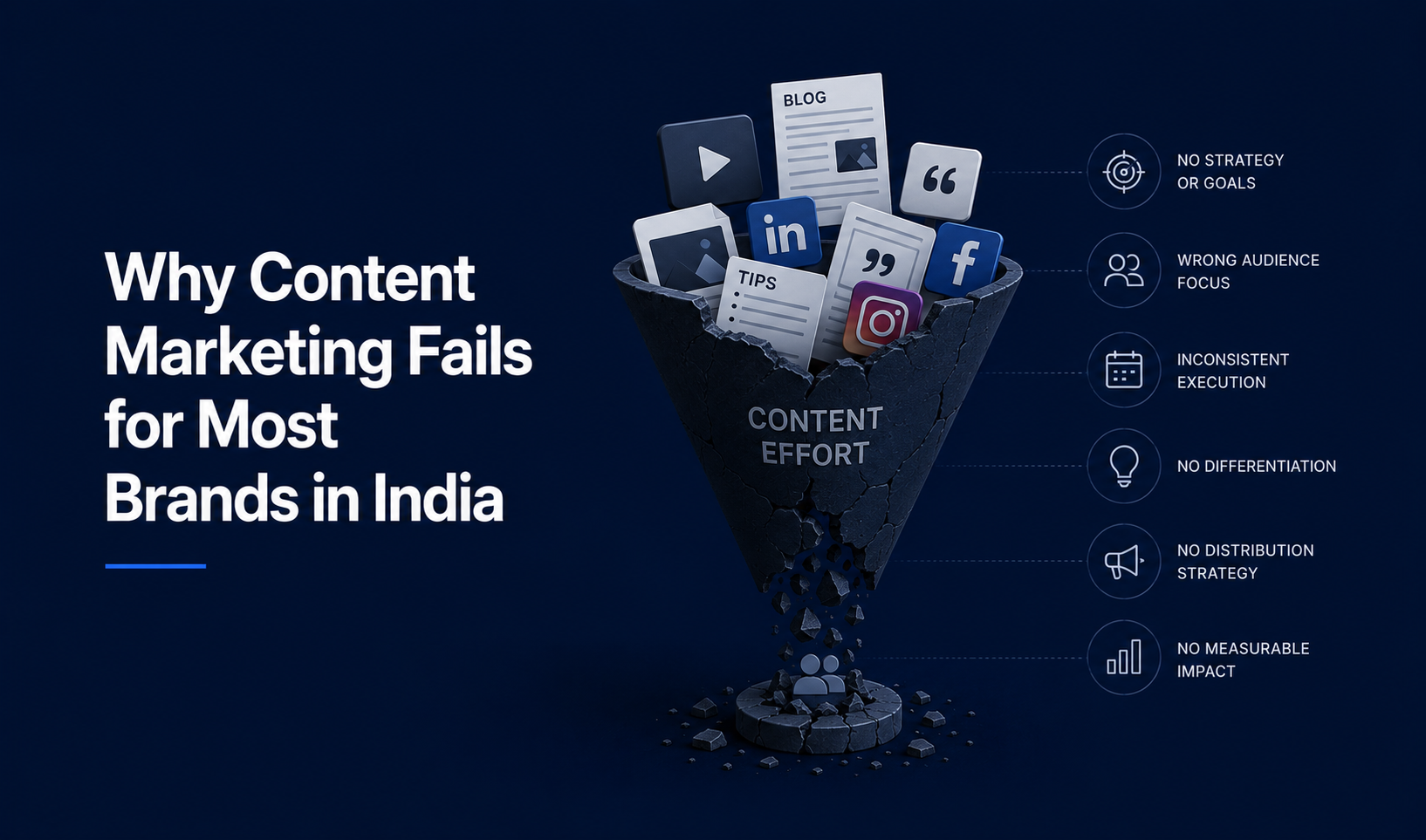
Almost every brand today is creating content.
Instagram posts, LinkedIn updates, YouTube videos, blogs, reels—there’s constant activity across platforms. Yet despite all this output, many businesses still struggle to see meaningful results.
Engagement stays inconsistent. Reach fluctuates. Leads don’t improve. Sales remain disconnected from content efforts.
The problem is rarely lack of content. It’s lack of direction.
Content marketing in India has become heavily focused on volume and trends, while strategy, positioning, and consistency are often overlooked. As a result, brands stay active without becoming memorable.
If your content feels busy but ineffective, here’s where things usually go wrong—and what actually works instead.
Most Brands Create Content Without a Clear Positioning
One of the biggest reasons content marketing fails is that brands don’t know what they want to be known for.
Without clear positioning, content becomes reactive:
- Following trends
- Copying competitors
- Posting whatever feels relevant that week
This creates inconsistency. Audiences may see your content, but they don’t build a clear understanding of your brand.
Strong content starts with clarity:
- What specific space do you want to occupy?
- What perspective do you bring?
- What problems are you helping solve?
Without these answers, content becomes noise.
Visibility Is Not the Same as Recall
A lot of content gets views. Very little gets remembered.
This is an important distinction.
Many brands optimize purely for reach and engagement:
- Trending audio
- Viral formats
- Clickbait hooks
These can increase visibility temporarily, but they don’t necessarily build long-term brand recall.
Effective content marketing creates familiarity over time. It reinforces:
- A clear point of view
- A recognizable style
- Consistent messaging
This is what helps audiences remember your brand when they’re ready to buy—not just when they’re scrolling.
Posting Frequently Doesn’t Automatically Create Growth
There’s a common assumption that consistency alone leads to results.
“Post daily.”
“Stay active.”
“Keep the algorithm happy.”
But frequency without strategic direction usually leads to repetitive content and audience fatigue.
The better question is not:
“How often are we posting?”
It’s:
“What role does each piece of content play?”
Good content systems balance:
- Awareness content
- Educational content
- Trust-building content
- Conversion-focused content
Without this structure, brands end up producing volume without progression.
Content and Performance Marketing Are Often Disconnected
One of the biggest gaps in Indian marketing setups is the disconnect between organic content and paid advertising.
Social media teams create one type of content. Performance marketing teams run another.
This creates fragmentation:
- Different messaging
- Different visual styles
- Different brand tone across channels
Strong brands integrate both functions.
Organic content should:
- Support positioning
- Test messaging ideas
- Build audience familiarity
Performance marketing should:
- Scale what resonates
- Reinforce the same brand narrative
- Drive conversion from existing interest
When content and performance align, marketing becomes significantly more effective.
Generic Content Is Easier Than Specific Content
AI tools and content templates have made production easier than ever. But they’ve also increased sameness.
A lot of brand content today feels interchangeable because it avoids specificity.
Generic content sounds safe:
- “Quality matters.”
- “Consistency is key.”
- “Work hard and stay focused.”
But safe content rarely creates attention or trust.
Specific content performs better because it feels real:
- Clear observations
- Practical experiences
- Strong opinions backed by understanding
This is especially important in competitive categories where differentiation is difficult.
Content Should Reflect the Stage of the Business
Different businesses need different content strategies.
An early-stage D2C brand in India may need:
- Product education
- Founder storytelling
- Trust-building content
A more established brand may focus on:
- Authority and category leadership
- Community building
- Retention-focused communication
Many content strategies fail because they copy businesses at completely different stages.
What works for a large consumer brand may not work for a growing startup with limited recognition.
Distribution Matters More Than Most Brands Think
Even strong content needs distribution.
Many brands assume good content will naturally perform. In reality, reach is increasingly limited across platforms.
This is why distribution strategy matters:
- Repurposing content across formats
- Using paid amplification where needed
- Leveraging creators and partnerships
- Optimizing for platform behavior
Content marketing is no longer just about creation. Distribution is part of the system.
Measuring the Wrong Metrics Creates Confusion
A common issue in content marketing is over-focusing on vanity metrics:
- Likes
- Follower counts
- Views
These metrics can be useful signals, but they don’t always reflect business impact.
More important questions include:
- Is the audience becoming more familiar with the brand?
- Are inquiries or conversions improving?
- Is content supporting retention and trust?
Content marketing is often a long-term function. Measuring it only through short-term engagement creates unrealistic expectations.
What Actually Works in 2026
The brands seeing strong results from content marketing in India are usually doing a few things consistently:
- Clear positioning
- Distinct brand voice
- Strong integration between content and performance marketing
- Consistent visual systems
- Distribution-focused thinking
Most importantly, they treat content as part of a larger business strategy—not just a social media activity.
Building a Content System That Lasts
Content marketing works best when it’s structured.
That means:
- Clear themes and messaging pillars
- Alignment across platforms
- Defined role for each content type
- Feedback loops from performance data
Without systems, content becomes difficult to sustain and harder to scale.
At Mantle International, content marketing is approached as part of a broader brand and growth system. From strategy and positioning to production and performance marketing, the focus is on building content that not only looks active—but actually drives recognition, trust, and business outcomes.
We’ve worked with brands across India and global markets where the biggest shift came not from posting more, but from building clearer direction and stronger integration across channels.
If your content marketing feels inconsistent or disconnected from growth, you can reach out to us at hello@mantle.international or book a call.