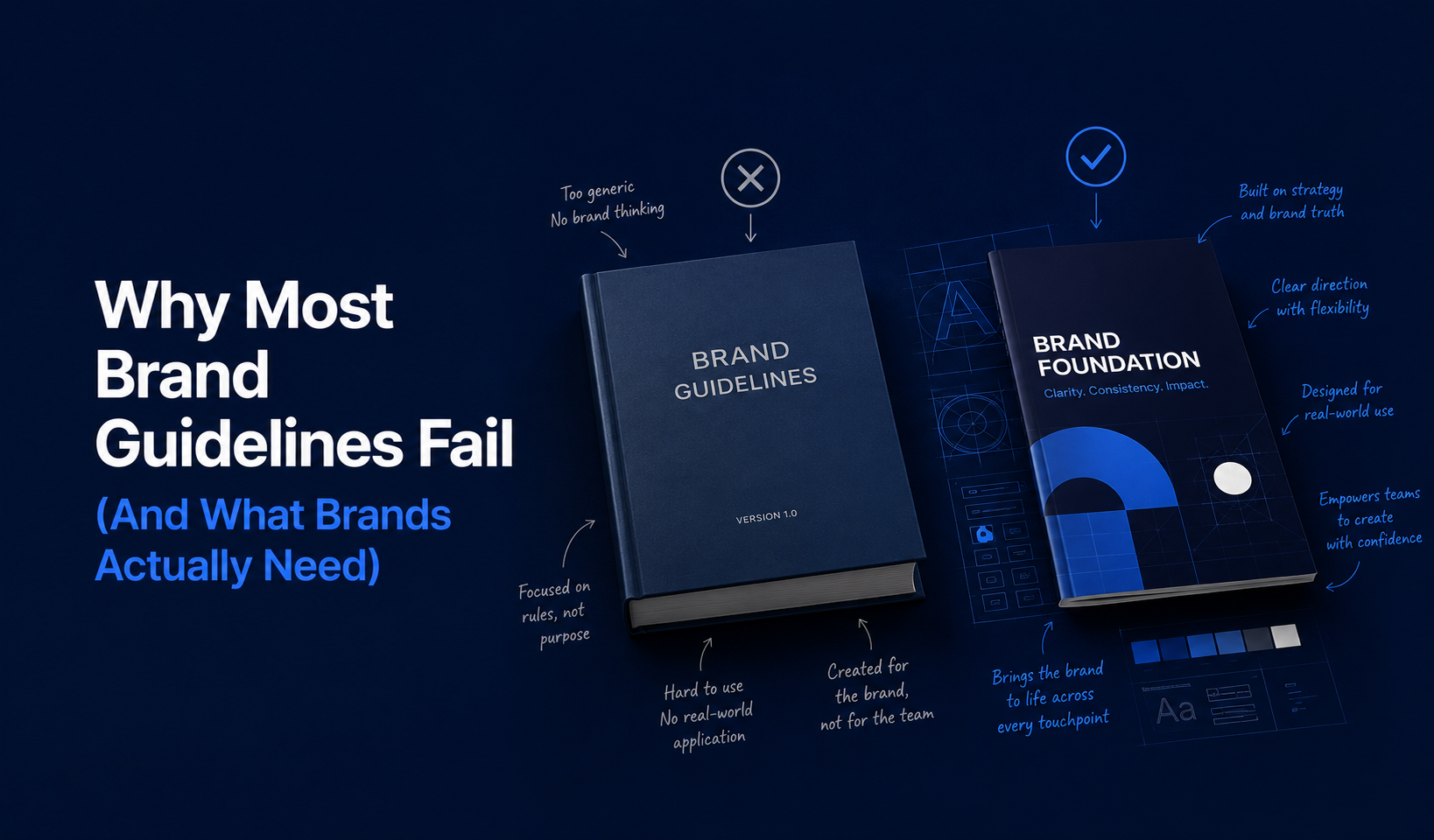
Many companies invest heavily in branding, only to end up with a brand guideline document that nobody really uses.
The file exists. It gets shared after the project is complete. And then, slowly, teams go back to making decisions on instinct.
Social media starts looking inconsistent. Ad creatives drift away from the original identity. Sales decks feel disconnected from the website. Over time, the brand loses coherence—not because the identity was weak, but because the system wasn’t usable.
This is one of the biggest problems with brand guidelines today: they are often designed to present a brand, not operate one.
If you’re working with a branding agency in India or building a brand system internally, it’s important to understand what brand guidelines should actually do.
Most Brand Guidelines Are Too Theoretical
A common issue is that guidelines focus heavily on definition and not enough on application.
They explain:
- Logo usage
- Color palettes
- Typography choices
- Spacing systems
But they rarely answer practical questions like:
- How should Meta ad creatives look?
- What changes between Instagram and LinkedIn?
- How should presentation decks be structured?
- What tone should customer support communication use?
As a result, teams still improvise during execution.
The problem is not lack of information—it’s lack of operational clarity.
A Brand System Needs to Work in Real Conditions
Branding today exists across multiple environments:
- Social media
- Performance marketing
- Websites
- Packaging
- Video content
- Sales and internal communication
This means guidelines need to support real-world use cases—not just ideal mockups.
For example:
A design system may look clean in static presentations but become difficult to adapt for fast-moving content production.
This creates friction for:
- Internal teams
- Social media agencies
- Performance marketing teams
- Production partners
When teams constantly need approval for basic decisions, the system is too rigid—or too incomplete.
Consistency Is Built Through Clarity, Not Control
Many brands attempt to maintain consistency by tightly controlling design decisions.
But this approach doesn’t scale.
As brands grow, more people interact with the identity:
- Designers
- Content creators
- Ad agencies
- Sales teams
- Freelancers and vendors
The only sustainable way to maintain consistency is through clarity.
Strong brand guidelines make decision-making easier:
- What visual styles are acceptable?
- What tone should communication follow?
- What should never happen visually or verbally?
Good systems reduce ambiguity instead of increasing dependency.
Visual Identity Alone Is Not Enough
One of the biggest misconceptions is that brand guidelines are only visual documents.
In reality, strong brand systems also define:
- Messaging structure
- Tone of voice
- Writing principles
- Communication hierarchy
Without this, visual consistency alone won’t create a recognizable brand experience.
For example:
A brand may maintain the same colors and fonts across channels, but if messaging constantly changes in tone or positioning, the identity still feels fragmented.
Brand guidelines should align both visuals and communication.
Performance Marketing Needs Brand Structure Too
One area where brand guidelines often fail is performance marketing.
Ad teams are usually forced to adapt branding independently because the system wasn’t designed with advertising in mind.
This leads to:
- Inconsistent ad creatives
- Weak brand recall
- Random messaging shifts
Strong guidelines should support:
- Meta ad formats
- Landing page structures
- Video content systems
- Campaign-based design adaptations
This is increasingly important as brands scale paid acquisition across multiple channels.
Simplicity Makes Systems More Usable
Some guideline documents become overly detailed and difficult to navigate.
The intention is usually good—cover every possible scenario. But in practice, complexity reduces adoption.
The best brand systems are:
- Clear
- Practical
- Easy to reference quickly
Teams should not need long onboarding sessions to understand basic usage.
Usability matters just as much as design quality.
Brands Evolve—Guidelines Should Too
Another reason guidelines fail is that they remain static while the brand evolves.
New products launch. New platforms emerge. Marketing styles shift.
But the guideline document stays frozen in time.
Strong brand systems are adaptable. They create structure without preventing evolution.
This means:
- Updating examples over time
- Expanding usage cases
- Refining communication frameworks
- Adjusting for new content formats
A brand is not a fixed asset. It’s a living system.
What Brands Actually Need
Instead of a presentation-heavy document, brands need:
- A practical operating system
- Clear visual and messaging rules
- Platform-specific guidance
- Flexibility for execution teams
- Alignment between branding and marketing
The goal is not perfection. It’s consistency at scale.
A useful guideline system should help teams move faster—not slow them down.
Choosing the Right Branding Partner
If you’re building or rebuilding your brand system, evaluate agencies based on how practical their thinking is.
Ask:
- How will this system work across social media and performance marketing?
- How will internal teams use it day-to-day?
- How adaptable is it as the brand grows?
The answers matter more than the number of pages in the final document.
At Mantle International, brand guidelines are built as operational systems—not static presentations. From identity and messaging to performance marketing integration, every framework is designed for real-world use across platforms and teams.
We’ve worked with brands across India and global markets where stronger systems significantly improved execution consistency and marketing efficiency.
If you’re building a new brand system or refining an existing one, you can reach out to us at hello@mantle.international or book a call.